
Introduction
Your nervous system is listening to your life all day long. It notices your deadlines, your sleep, your posture, your breathing, your phone notifications, and even the way you rush from one task to the next. That is why the best exercises for nervous system support are not always the hardest workouts. Often, they are the simple, repeatable movements that tell your body, “You are safe enough to soften now.”
This matters because a tense, overworked nervous system can show up in very ordinary ways: tight shoulders, shallow breathing, poor sleep, a racing mind, jaw tension, digestive discomfort, irritability, or feeling tired but wired. Exercise cannot fix every cause of stress or nerve-related symptoms, but the right kind of movement can help your body shift from constant alert mode toward steadier energy, clearer focus, and deeper recovery.
Think of this guide as a practical menu. You do not need to do everything. You only need to choose the movements that match your body, your schedule, and your current stress level. Some days that may mean a brisk walk. Other days it may mean slow breathing, gentle stretching, or lying on the floor with your legs supported. The goal is not perfection; it is regulation.
How Exercise Supports the Nervous System
The nervous system includes the brain, spinal cord, nerves, and the automatic body systems that help control heart rate, breathing, digestion, sweating, and blood pressure. One important part is the autonomic nervous system, which includes the sympathetic “fight-or-flight” response and the parasympathetic “rest-and-digest” response. A healthy body needs both. You want enough alertness to act, move, think, and protect yourself, but enough recovery to rest, digest, repair, and sleep.
Movement affects this system through several pathways. It changes breathing rhythm, improves circulation, releases muscular tension, supports sleep, and gives the brain fresh sensory information from the body. When you move in a steady, intentional way, your body receives signals that can reduce the feeling of threat. That is one reason a walk, stretch, or slow breathing session can make a stressful day feel more manageable.
The best exercises for nervous system regulation usually combine three things: rhythm, breath, and body awareness. Rhythm gives the brain predictability. Breath helps influence arousal. Body awareness teaches you to notice tension before it becomes overwhelming. This is why gentle, consistent practice often works better than pushing hard once and then stopping for weeks.
It is also important to respect intensity. High-intensity exercise can be helpful for many people, especially when balanced with recovery, but it may feel too activating during periods of burnout, poor sleep, illness, trauma recovery, or severe anxiety. In those seasons, lower-intensity exercise may be a better starting point.
Best Exercises for Nervous System Health and Daily Calm
Below are the best exercises for nervous system support when your goal is to feel calmer, steadier, and more connected to your body. You can mix them throughout the week or choose one small practice to repeat daily.
1. Diaphragmatic Breathing
Diaphragmatic breathing, also called belly breathing, is a breathing exercise that encourages the diaphragm to move more fully. Instead of lifting your shoulders and breathing high into the chest, you breathe low and slow, allowing the ribs and belly to expand gently.
To practice it, sit comfortably or lie down. Place one hand on your chest and one hand on your abdomen. Breathe in through your nose for about four seconds, letting the lower hand rise slightly. Exhale slowly for about six seconds. Keep the shoulders relaxed and repeat for two to five minutes.
This exercise is useful because the breath is one of the easiest ways to communicate with the autonomic nervous system. Slow breathing can reduce the sense of urgency in the body and create a more grounded state. You can use it before sleep, before a difficult conversation, after work, or any time you notice shallow breathing.
2. Box Breathing
Box breathing is a structured breathing pattern that uses equal counts for inhaling, holding, exhaling, and holding again. It gives the mind a clear rhythm, which can be helpful when thoughts feel scattered.
Try this pattern: inhale for four counts, hold for four counts, exhale for four counts, and hold for four counts. Repeat four to eight rounds. If holding the breath feels uncomfortable, shorten the count or skip the holds and simply breathe in and out slowly.
Box breathing is not about forcing calm. It is about creating a steady container for your attention. For some people, this is one of the best exercises for nervous system balance during work stress because it can be done quietly at a desk, in the car before an appointment, or between meetings.
3. Walking at a Comfortable Pace
Walking is simple, but it is powerful. It combines rhythm, bilateral movement, visual flow, and gentle cardiovascular activity. When you walk, the left and right sides of the body move in an alternating pattern, which may help the brain process stress while the body releases physical tension.
For nervous system support, the pace does not need to be intense. A 10- to 20-minute walk at a comfortable speed can be enough to change your state. If possible, walk outdoors where your eyes can look at trees, sky, sunlight, or open space. If you are indoors, a hallway, treadmill, or even slow laps around the house can still help.
To make walking more calming, breathe through your nose if comfortable, relax your jaw, and let your arms swing naturally. Notice your feet meeting the ground. This turns walking from a basic task into a regulation practice.
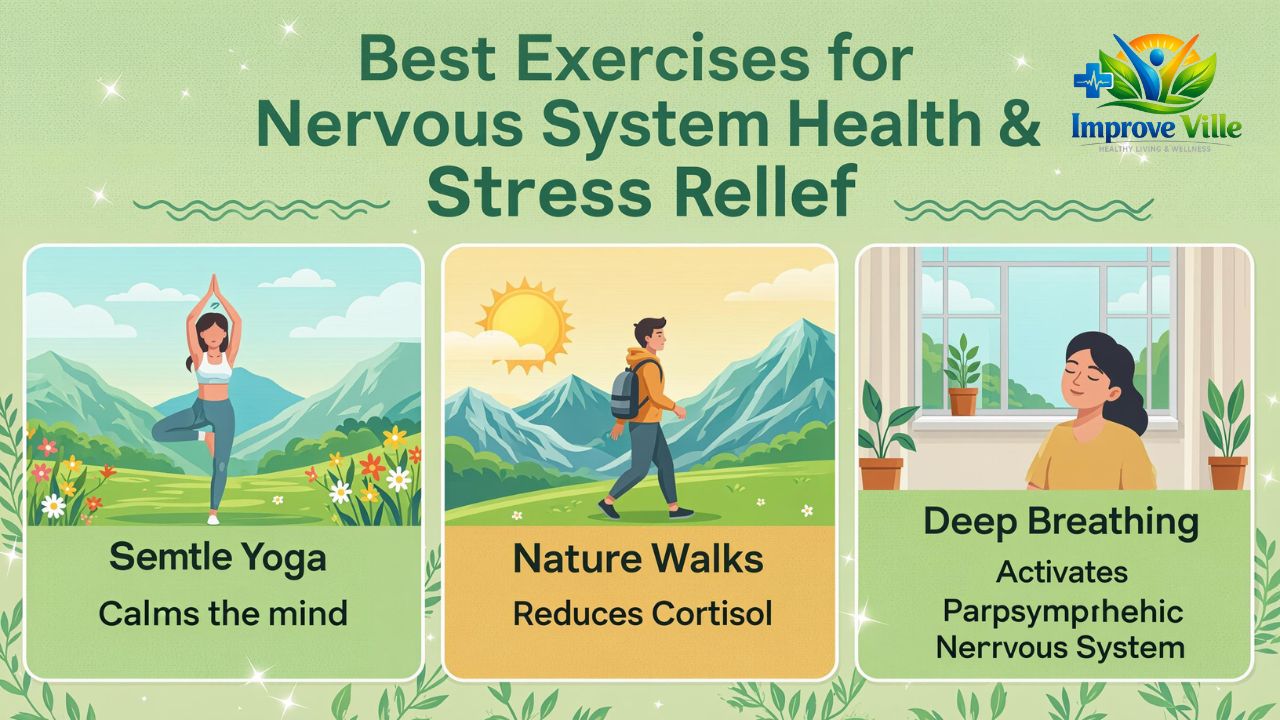
4. Gentle Yoga
Gentle yoga combines movement, stretching, posture, breath, and attention. It is different from a fast or highly athletic yoga class. The goal is not to perform impressive poses; it is to create space in the body and build a calmer relationship with sensation.
Good beginner-friendly poses include child’s pose, cat-cow, seated forward fold, supported bridge, knees-to-chest, and legs-up-the-wall. Move slowly and avoid forcing the stretch. A mild pull is fine; sharp pain is not.
Gentle yoga is one of the best exercises for nervous system relaxation because it can reduce muscle guarding while encouraging slow breathing. It is especially useful in the evening, after long screen time, or when the body feels stiff from stress.
5. Tai Chi
Tai chi is a slow, flowing movement practice that blends balance, breath, posture, and focused attention. The movements are usually gentle and controlled, making it accessible for many ages and fitness levels.
A basic tai chi session may include weight shifting, soft knee bends, circular arm movements, and slow stepping. The nervous system benefits come from the combination of relaxed focus and continuous movement. Instead of rushing, you learn to move with control and awareness.
Tai chi can be especially helpful for people who dislike traditional workouts or feel overwhelmed by fast exercise. It gives the body something to do while giving the mind a softer place to rest.
6. Qigong
Qigong is another gentle mind-body practice that uses slow movement, breath, posture, and awareness. Many qigong exercises are simple enough to learn at home and can be practiced standing or seated.
One easy movement is “lifting the sky.” Stand with feet hip-width apart. As you inhale, float your arms forward and upward. As you exhale, lower them slowly. Keep the shoulders soft and repeat for one to three minutes. Another option is gentle shaking: stand with soft knees and lightly bounce or shake the arms and legs to release tension.
Qigong works well when you feel stuck, heavy, or emotionally overloaded. The movements are not aggressive; they are designed to help energy feel less trapped in the body.
7. Progressive Muscle Relaxation
Progressive muscle relaxation is a technique where you gently tense and release different muscle groups. It helps you recognize the difference between tension and relaxation, which is valuable if you carry stress without noticing it.
Start with your feet. Gently tense the muscles for five seconds, then release for ten to fifteen seconds. Move up through calves, thighs, hips, abdomen, hands, arms, shoulders, face, and jaw. Keep the effort moderate, not painful.
This is one of the best exercises for nervous system recovery before bed because it gives the mind a body-based task and helps reduce physical tension. If tensing muscles feels unpleasant, you can do a softer version by simply noticing each body part and inviting it to relax.
8. Somatic Shaking
Somatic shaking is a simple practice where you gently shake the body to discharge tension. Animals often shake after a stressful event; humans sometimes suppress that natural release. Done safely, shaking can help the body move out of a frozen or braced state.
Stand with feet comfortable and knees soft. Begin by lightly bouncing through the knees. Let the arms hang and shake gently. Keep the jaw loose. Continue for 30 seconds to two minutes, then pause and notice how your body feels. You can also shake one arm or one leg at a time.
The key is gentleness. This is not a performance or a workout challenge. If you feel dizzy, overwhelmed, or disconnected, stop and return to slow breathing or seated grounding.
9. Mobility Exercises
Mobility exercises move joints through comfortable ranges of motion. They are especially useful when stress makes the body feel tight, locked, or compressed. Unlike deep stretching, mobility work is usually active and controlled.
Try slow neck circles, shoulder rolls, wrist circles, hip circles, ankle circles, and gentle spinal twists. Move within a pain-free range. The purpose is to wake up the body’s map of itself, not to force flexibility.
Mobility is helpful during work breaks because it interrupts the stress posture many people hold at a desk: forward head, rounded shoulders, tight hips, and shallow breathing. Two minutes can make a noticeable difference.
10. Strength Training With Slow Control
Strength training may not seem calming at first, but it can support the nervous system when done with good technique, steady breathing, and enough rest. Building strength gives the body a sense of capacity. You feel less fragile and more physically prepared for daily life.
Start with basic movements such as squats to a chair, wall push-ups, glute bridges, step-ups, rows with a resistance band, or light dumbbell carries. Use a pace that lets you stay in control. Exhale during effort and avoid holding your breath.
For many adults, two days per week of muscle-strengthening activity is a realistic target. The nervous system often responds well to predictable training: not too much, not too random, and not so intense that recovery becomes harder.
11. Dancing or Rhythmic Movement
Dancing is underrated nervous system medicine. It combines rhythm, music, coordination, emotion, and self-expression. You do not need formal steps. Put on one song and move in any way that feels good.
Rhythm can help organize the body. Music can shift mood. Movement can release energy that talking alone does not always reach. This makes dancing one of the best exercises for nervous system activation when you feel flat, low, or emotionally stuck.
Keep it simple. Sway, step side to side, roll your shoulders, or move your hands. The goal is not to look good; the goal is to feel present.
12. Balance Training
Balance exercises challenge the brain and body to communicate more clearly. They improve proprioception, which is your sense of where your body is in space. Better body awareness can help you feel more grounded.
Try standing on one foot near a wall, heel-to-toe walking, slow marching, or standing on a cushion while holding support. Keep the practice safe. If you are older, dizzy, injured, or at risk of falling, practice with a stable chair or professional guidance.
Balance work is especially useful because it demands attention without emotional overthinking. You have to be in the present moment, which can quiet mental noise.
A 10-Minute Nervous System Reset Routine
When you do not know where to start, use this short routine. It is gentle enough for most days and does not require equipment.
Begin with two minutes of diaphragmatic breathing. Then do two minutes of mobility: neck turns, shoulder rolls, wrist circles, and slow hip circles. Follow with three minutes of gentle yoga, such as cat-cow, child’s pose, and a seated forward fold. Add two minutes of slow walking or marching in place. Finish with one minute of stillness, noticing your breath and the feeling of your feet or body supported.
This routine includes several of the best exercises for nervous system support in one simple flow: breath, movement, rhythm, stretching, and grounding. You can do it in the morning to start steady, at lunch to reset, or at night to downshift.
How to Choose the Right Exercise for Your Current State
Your nervous system does not need the same thing every day. Sometimes it needs calming. Sometimes it needs safe activation. Sometimes it needs rest. The skill is learning to match the exercise to your state.
If you feel anxious, wired, or overstimulated, start with slow breathing, gentle yoga, walking, progressive muscle relaxation, or legs-up-the-wall. If you feel numb, heavy, or stuck, try walking, qigong, dancing, light strength training, or somatic shaking. If you feel scattered and unfocused, choose box breathing, balance training, tai chi, or a short mobility sequence.
A helpful rule is to begin smaller than you think you need. If your body feels better after five minutes, you can continue. If it feels worse, stop and choose something gentler. Nervous system work is not about pushing through warning signs; it is about building trust with your body.
Common Mistakes to Avoid
The first mistake is turning regulation into another pressure-filled task. If you are judging your breathing, forcing flexibility, or criticizing yourself for not feeling calm fast enough, your body may interpret the practice as more stress.
The second mistake is choosing exercise that is too intense for your current recovery level. Hard workouts can be healthy, but if you are sleeping poorly, under-eating, overworking, or dealing with high stress, intense training may need to be balanced with more recovery-based movement.
The third mistake is inconsistency. Ten minutes a day usually helps more than one long session once a month. The nervous system learns through repetition. Small, predictable signals of safety add up.
When to Be Careful or Get Professional Help
Most gentle exercises are safe for many people, but not every symptom should be handled alone. Speak with a healthcare professional if you have fainting, chest pain, unexplained numbness, severe dizziness, sudden weakness, seizures, loss of coordination, new severe headaches, or symptoms after an injury.
You should also get support if exercise triggers panic, flashbacks, dissociation, or intense emotional distress. In that case, a trauma-informed therapist, physical therapist, or qualified clinician can help you find safer starting points.
If you have a diagnosed nervous system disorder, heart condition, blood pressure issue, pregnancy-related concern, chronic pain condition, or recent surgery, ask a professional before beginning a new exercise routine.
FAQ
What are the best exercises for nervous system calming?
The most calming options are usually diaphragmatic breathing, slow walking, gentle yoga, progressive muscle relaxation, tai chi, qigong, and mobility exercises. These practices combine slow rhythm, breath awareness, and relaxed attention, which can help the body move toward a steadier state.
How often should I do nervous system exercises?
Most people do well with five to fifteen minutes daily. You can also add short resets during stressful moments. Consistency matters more than long sessions. A few minutes of breathing, walking, or stretching every day can teach your body to recover more easily.
Can exercise heal a dysregulated nervous system?
Exercise can support regulation, sleep, mood, circulation, and body awareness, but it is not a cure for every nervous system problem. If symptoms are severe, sudden, or interfering with daily life, it is wise to work with a healthcare professional.
Is high-intensity exercise good for the nervous system?
It can be, especially for healthy people who recover well. However, high-intensity exercise is also stimulating. If you are burned out, anxious, injured, or sleep deprived, start with gentler movement and increase intensity gradually.
Why do I feel emotional after stretching or yoga?
The body often holds tension during stress. When you slow down, breathe, and release muscle tightness, emotions may become more noticeable. This does not mean something is wrong. Move gently, pause when needed, and seek support if the emotions feel overwhelming.
Are breathing exercises enough by themselves?
Breathing exercises are helpful, but they work best as part of a broader routine that includes movement, sleep, hydration, nourishment, sunlight, social connection, and healthy boundaries. The nervous system responds to your whole lifestyle, not one technique alone.
What is the fastest nervous system reset?
For many people, the fastest reset is a two-minute pattern: slow exhale breathing followed by gentle movement. Try inhaling for four counts, exhaling for six counts, then walking slowly or rolling your shoulders. This gives the body both breath and motion signals.
Can I do these exercises before bed?
Yes. Evening is a great time for diaphragmatic breathing, progressive muscle relaxation, gentle yoga, legs-up-the-wall, or slow stretching. Avoid intense workouts close to bedtime if they make you feel alert.
Conclusion
The best exercises for nervous system support are not about punishing your body into calm. They are about giving your body repeated experiences of safety, rhythm, strength, and recovery. A nervous system that has been running on high alert often needs patience, not pressure.
Start with one practice that feels easy enough to repeat. Breathe slowly for three minutes. Walk after dinner. Stretch before bed. Shake out tension after a difficult call. Do a few controlled strength movements twice a week. Over time, these small choices can help your body feel less reactive and more resilient.
You do not have to become a different person to feel better. You only need to build a few steady habits that remind your body how to return to balance.