
Introduction
Some days, your body feels like it has one foot on the gas and one foot on the brake. Your mind is tired, your muscles are tense, your sleep is patchy, and even small tasks feel strangely heavy. That is often when people start looking for the best exercises for nervous system support—not just workouts that burn calories, but movements that help the body feel safer, steadier, and more resilient.
Your nervous system is involved in nearly everything you experience: breathing, heart rate, digestion, balance, focus, pain sensitivity, emotional reactions, and recovery after stress. When it is constantly pushed by deadlines, poor sleep, screens, illness, trauma, or overtraining, the goal is not to “hack” it. The goal is to give it repeated signals of safety through breath, rhythm, movement, strength, and rest.
The good news is that you do not need extreme routines to feel a difference. In many cases, gentle, consistent exercises work better than forcing your way through intense workouts when your body is already overwhelmed. The right practice can help you downshift after stress, build confidence in your body, improve coordination, and support better sleep.
This guide walks through the most practical, evidence-informed movements you can use at home, at the gym, or even beside your desk. Think of it as a menu, not a strict program. Your body may respond best to breathwork one day, walking the next, and strength training later in the week.
What Does It Mean to Exercise Your Nervous System?
Exercising your nervous system means using movement, breath, sensory input, and coordination to influence how your body responds to stress and recovery. It is not about controlling every reaction. It is about practicing patterns that help your brain and body move more smoothly between alertness and calm.
The nervous system includes the brain, spinal cord, nerves, and the autonomic nervous system, which helps regulate automatic functions such as breathing, heart rate, and digestion. The sympathetic branch prepares you for action. The parasympathetic branch supports rest, repair, and digestion. A healthy system is not calm all the time; it is flexible enough to activate when needed and settle when the moment has passed.
That flexibility is why the best exercises for nervous system health include both calming and strengthening practices. Slow breathing can help the body settle. Balance drills sharpen communication between the brain, joints, eyes, and inner ear. Walking provides rhythm and circulation. Strength training teaches the body to handle effort without panic.
A useful nervous system routine should leave you feeling more connected to your body, not punished by it. If an exercise makes you feel dizzy, panicky, numb, or unusually exhausted, that is a sign to reduce the intensity or choose something gentler.
The Best Exercises for Nervous System Regulation
The best exercises for nervous system regulation are usually simple, repeatable, and easy to scale. They combine breathing, rhythm, posture, attention, and physical feedback. You can do them separately or blend them into a short daily practice.
Before you begin, remember this rule: your nervous system learns through consistency. A five-minute practice you repeat most days is often more useful than a complicated one-hour session you only do when life falls apart.
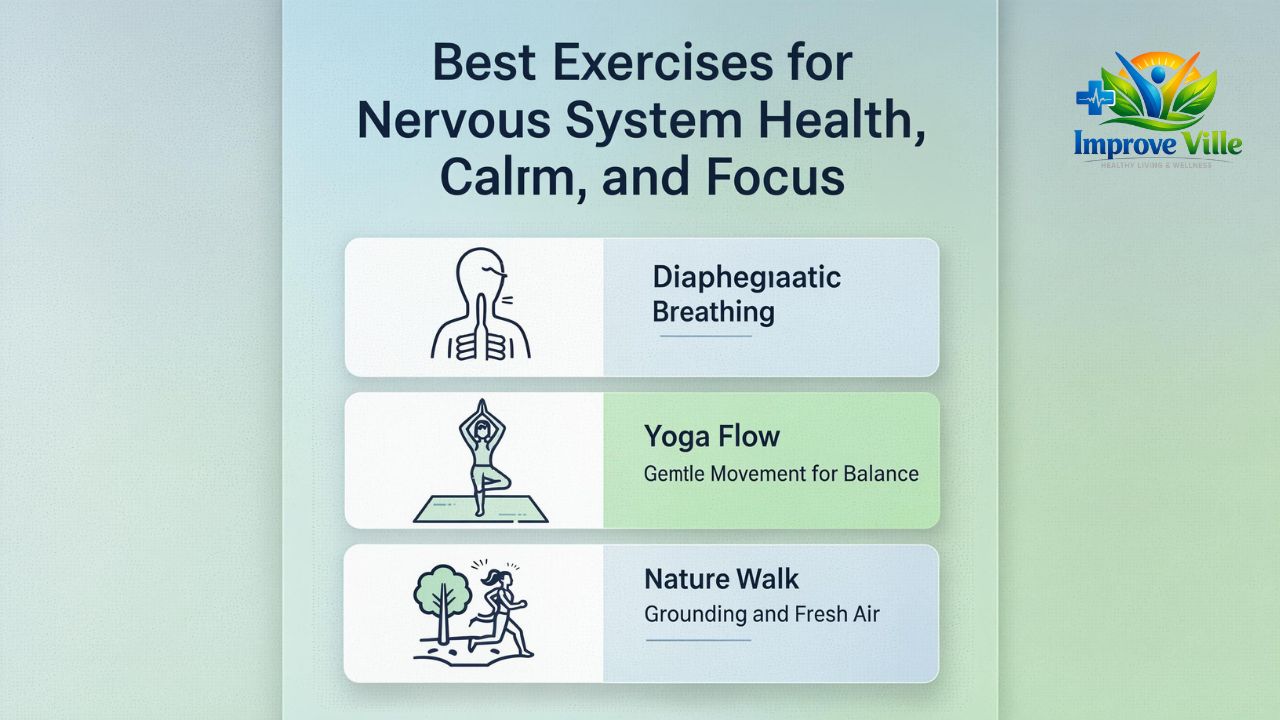
1. Diaphragmatic Breathing
Diaphragmatic breathing, often called belly breathing, is one of the most accessible ways to send a calming signal to the body. It encourages slower, deeper breathing by using the diaphragm rather than shallow chest breathing.
Try this:
- Sit or lie down comfortably.
- Place one hand on your chest and one on your belly.
- Inhale through your nose for about four seconds.
- Let your belly gently expand.
- Exhale slowly for six to eight seconds.
- Repeat for three to five minutes.
The longer exhale matters. It gives your body a clear cue that you are not in immediate danger. Many people notice their shoulders drop, jaw unclench, or thoughts slow down after a few rounds.
This is one of the best exercises for nervous system calming because it can be done almost anywhere: in bed, before a meeting, after an argument, or during a stressful commute when you are not driving.
2. Box Breathing
Box breathing adds structure to the breath, which can be helpful when your mind feels scattered. It uses four equal parts: inhale, hold, exhale, hold.
A common pattern is:
- Inhale for four counts.
- Hold for four counts.
- Exhale for four counts.
- Hold for four counts.
Repeat for one to three minutes. If holding your breath feels uncomfortable, shorten the holds or skip them. The goal is not to prove discipline; it is to create rhythm.
Box breathing can be especially useful before high-pressure moments because it gives the mind something steady to follow. Athletes, performers, and professionals often use breathing patterns like this to shift from reactive stress into focused readiness.
3. Physiological Sigh
The physiological sigh is a quick breathing pattern that many people find useful when stress spikes suddenly. It involves a deep inhale, a second small inhale on top, and a long exhale.
Try it like this:
- Take a deep breath in through your nose.
- Before exhaling, take a second smaller sip of air.
- Exhale slowly through the mouth.
- Repeat two to five times.
This can feel surprisingly effective because it releases built-up tension in the breathing system. Use it when you feel a wave of anxiety, frustration, or overstimulation. It is short, discreet, and easy to remember.
4. Slow Walking
Walking may seem too ordinary to count, but it is one of the most powerful nervous system exercises because it gives the body rhythm, visual flow, joint movement, and steady breathing all at once.
For nervous system support, try a slow walk without multitasking. Leave your phone in your pocket. Notice your feet touching the ground. Let your arms swing naturally. Look around softly instead of staring at one fixed point.
A ten-minute walk can help transition your body out of mental overload. Morning walks may help you feel more awake and grounded. Evening walks may help your body separate the stress of the day from the rest of the night.
If you are looking for the best exercises for nervous system balance, walking deserves a regular place in your routine. It is low-cost, scalable, and naturally rhythmic.
5. Gentle Mobility Flow
Mobility work helps your joints move through comfortable ranges of motion while giving your brain fresh sensory information. This is useful when stress makes the body feel stiff, guarded, or disconnected.
A simple flow might include:
- Neck circles, kept slow and pain-free
- Shoulder rolls
- Cat-cow movements
- Hip circles
- Seated spinal twists
- Ankle circles
- Wrist circles
Move slowly enough that you can feel what is happening. Avoid forcing end ranges. The goal is to remind the body that movement can be safe and smooth.
Mobility flows work well in the morning, during work breaks, or before more intense exercise. They are also a good option on days when you want to move but do not have energy for a full workout.
6. Progressive Muscle Relaxation
Progressive muscle relaxation teaches the body the difference between tension and release. You gently tense a muscle group, hold briefly, then relax it.
Start with your feet and move upward:
- Curl your toes for five seconds, then release.
- Tighten your calves, then release.
- Squeeze your thighs, then release.
- Tighten your hands, arms, shoulders, face, and jaw, then release each area.
This is especially helpful for people who carry stress physically but do not notice it until they have a headache, tight chest, clenched jaw, or aching back.
Because it builds body awareness, progressive muscle relaxation is one of the best exercises for nervous system recovery after a demanding day. It can also be helpful before sleep.
7. Yoga
Yoga combines movement, breath, posture, and attention. Not every style has the same effect, though. If your nervous system feels overloaded, choose gentle, restorative, or slow-flow yoga rather than heated or intense classes.
Helpful poses may include:
- Child’s pose
- Legs up the wall
- Cat-cow
- Reclined twist
- Supported bridge
- Savasana
The key is to practice in a way that feels spacious. If you are holding your breath, pushing into pain, or comparing yourself to others, the practice may become another stressor.
Gentle yoga is among the best exercises for nervous system support because it blends physical sensation with slow breathing and mindful attention.
8. Tai Chi
Tai chi uses slow, flowing movements with controlled breathing and weight shifting. It is often described as meditation in motion, but it is also a coordination practice that challenges balance, posture, and focus.
What makes tai chi special is its pace. You move slowly enough to notice transitions. Your brain has to coordinate your feet, hips, spine, arms, breath, and gaze. That steady coordination can help you feel calmer without becoming passive or sleepy.
Tai chi is especially useful for people who dislike sitting meditation. It gives the mind a job while the body moves gently.
9. Balance Exercises
Balance training is direct communication practice for your nervous system. Your brain must process information from the eyes, inner ear, muscles, joints, and feet to keep you upright.
Try these beginner-friendly drills:
- Stand with feet hip-width apart and shift weight side to side.
- Stand heel-to-toe near a wall.
- Practice single-leg standing while lightly touching a chair.
- Walk slowly in a straight line.
- Try controlled step-ups on a low step.
Keep the challenge mild. Shaking is not failure; it is feedback. Your nervous system improves by receiving feedback and adjusting.
Balance work is one of the best exercises for nervous system coordination, especially as part of a warm-up or daily movement break.
10. Strength Training
Strength training may not seem calming at first, but it can be deeply supportive when done with good pacing. Lifting, pushing, pulling, squatting, and carrying teach the body that effort is manageable.
Start with basic movements:
- Squats to a chair
- Wall push-ups
- Hip hinges
- Glute bridges
- Rows with a band
- Farmer carries with light weights
Use a moderate effort level. You should be able to breathe and stay aware of your form. Rest between sets. Avoid turning every workout into a test of willpower.
The nervous system likes clear, successful signals. When you lift something safely and feel capable, your body learns strength, control, and confidence.
11. Rhythmic Cardio
Rhythmic cardio includes activities such as cycling, swimming, rowing, dancing, jogging, and elliptical training. The repeated pattern can be regulating when the intensity is appropriate.
For nervous system health, the sweet spot is often moderate effort. You feel warmer and more awake, but you are not gasping or pushing through dread. You can still speak in short sentences.
Over time, regular aerobic movement can support sleep, mood, circulation, and stress resilience. The important part is choosing a form you can repeat without feeling punished by it.
12. Somatic Shaking
Somatic shaking involves intentionally letting the body shake or tremble in a controlled, safe way. It may help discharge physical tension, especially when you feel frozen, wired, or restless.
Try this gently:
- Stand with knees soft.
- Let your heels bounce lightly.
- Allow small shaking through the legs, arms, and shoulders.
- Keep breathing.
- Stop after 30 to 90 seconds and stand still.
Afterward, notice what changed. You may feel warmer, calmer, lighter, or simply more aware of your body. If shaking feels emotionally intense, stop and return to slow breathing or grounding.
13. Eye Movement and Visual Tracking Drills
Your visual system is closely tied to balance, orientation, and alertness. Gentle eye exercises can help when you have been staring at screens or feeling visually overwhelmed.
Try slow tracking:
- Hold your thumb in front of your face.
- Move it slowly left to right while your eyes follow.
- Keep your head still.
- Repeat up and down.
- Then look near and far a few times.
Do not push through dizziness or eye strain. Keep it light. These drills are not a replacement for medical care if you have vision problems, vertigo, or neurological symptoms, but they can be a useful part of a gentle reset routine.
14. Grounding Exercises
Grounding exercises use sensory input to help your brain recognize the present moment. They are especially helpful when you feel anxious, dissociated, overwhelmed, or mentally scattered.
A simple grounding practice:
- Feel both feet on the floor.
- Press your toes down gently.
- Notice five things you can see.
- Notice four things you can feel.
- Notice three things you can hear.
- Take three slow breaths.
You can combine grounding with walking, stretching, or breathing. The point is to bring attention back into the body and the environment you are actually in.
15. Humming or Extended Exhale Sounds
Humming, chanting, or making a long “voo” sound on the exhale can create vibration in the throat and chest. Many people find this soothing, especially when quiet breathing is not enough.
Try this:
- Inhale normally.
- Exhale with a low hum for as long as comfortable.
- Feel the vibration in your lips, throat, or chest.
- Repeat five to ten times.
This practice can feel awkward at first, but it is simple and grounding. It also lengthens the exhale naturally, which supports a calmer state.
How to Choose the Right Exercise for Your State
Not every exercise fits every moment. The best choice depends on whether you feel anxious and wired, flat and shut down, tense and guarded, or simply unfocused.
If you feel wired, start with:
- Longer exhale breathing
- Slow walking
- Gentle yoga
- Progressive muscle relaxation
- Humming
If you feel sluggish or shut down, try:
- Brisk walking
- Light strength training
- Mobility flow
- Upright posture drills
- Rhythmic music and movement
If you feel tense, try:
- Progressive muscle relaxation
- Somatic shaking
- Neck and shoulder mobility
- Diaphragmatic breathing
- Gentle stretching
If you feel unfocused, try:
- Balance drills
- Box breathing
- Walking without your phone
- Tai chi
- Visual tracking
This is why the best exercises for nervous system support are not one-size-fits-all. A calming exercise can be perfect at night but too quiet when you need energy. A cardio session can feel amazing on a good day but overwhelming when you are depleted.
A Simple 10-Minute Daily Routine
You do not need to do every exercise in this guide. Start with a small routine and adjust from there.
Try this 10-minute practice:
- One minute of diaphragmatic breathing
- Two minutes of gentle mobility
- Two minutes of balance work
- Three minutes of slow walking or marching in place
- One minute of humming or long exhales
- One minute of stillness to notice how you feel
This routine gives your nervous system several types of input: breath, joint movement, balance, rhythm, sound, and rest. That variety is useful because it helps the body practice shifting states.
For a longer version, add 10 to 20 minutes of walking or two sets of simple strength exercises. Keep the intensity manageable and finish before you feel drained.
Weekly Plan for Nervous System Support
A balanced week includes calming work, strength, mobility, and aerobic movement. Here is a simple template:
- Monday: Gentle strength training and five minutes of slow breathing
- Tuesday: Walk and mobility flow
- Wednesday: Yoga or tai chi
- Thursday: Strength training and balance drills
- Friday: Rhythmic cardio at moderate intensity
- Saturday: Longer outdoor walk
- Sunday: Restorative stretching, breathing, or progressive muscle relaxation
This plan is flexible. If your week is stressful, reduce intensity. If you feel strong and well-rested, add more challenge. Your nervous system responds best when exercise feels supportive rather than threatening.
The best exercises for nervous system health are the ones you can repeat consistently without ignoring your body’s signals.
Common Mistakes to Avoid
One common mistake is doing too much too soon. When people discover nervous system exercises, they sometimes build an intense routine full of breathwork, cold exposure, long workouts, and deep stretching. More is not always better. A sensitive system may need less intensity, not more.
Another mistake is chasing a perfect calm feeling. Regulation does not mean you never feel stress. It means you recover more smoothly. Some days, the win is not feeling peaceful; it is noticing tension sooner and choosing a healthier response.
People also make the mistake of using exercise as punishment. If your inner voice is harsh during every workout, your body may associate movement with pressure. Supportive movement should build trust.
Finally, avoid comparing your routine to someone else’s. Your nervous system has its own history, capacity, preferences, and recovery needs.
When to Be Careful
Most gentle nervous system exercises are safe for many people, but there are times to use caution. If you have a heart condition, uncontrolled blood pressure, fainting episodes, severe dizziness, recent surgery, neurological symptoms, pregnancy complications, or a history of trauma that makes body-based practices feel overwhelming, speak with a qualified healthcare professional.
Stop any exercise that causes chest pain, severe shortness of breath, faintness, sharp pain, numbness, or symptoms that feel unusual for you.
Breathwork also deserves respect. Aggressive breathing, long breath holds, or intense practices can make some people feel dizzy or panicky. Start with gentle patterns and stay within your comfort zone.
FAQ
What are the best exercises for nervous system calming?
The most calming options are usually diaphragmatic breathing, slow walking, gentle yoga, progressive muscle relaxation, tai chi, humming, and longer-exhale breathing. These practices combine slow rhythm, body awareness, and steady sensory input.
How often should I do nervous system exercises?
Most people do well with five to ten minutes daily. Consistency matters more than duration. You can add longer walks, strength sessions, yoga, or tai chi several times per week depending on your energy and fitness level.
Can exercise really help regulate the nervous system?
Yes, movement and breathing can influence heart rate, muscle tension, attention, balance, and stress recovery. Exercise gives the brain and body repeated signals that help them practice shifting between effort and rest.
Is intense exercise bad for the nervous system?
Not always. Intense exercise can be healthy when you are well-rested, properly fueled, and recovering well. But if you are already stressed, sleep-deprived, or burned out, high-intensity workouts may feel like another stressor. Match the workout to your current capacity.
Which is better for the nervous system: yoga or walking?
Both can help, but they work differently. Walking provides rhythm, circulation, and visual flow. Yoga adds breath, stretching, posture, and stillness. Many people benefit from using both throughout the week.
How quickly do nervous system exercises work?
Some exercises, like slow breathing or a physiological sigh, may create a shift within minutes. Deeper changes in stress resilience, sleep, strength, and emotional regulation usually come from repeated practice over weeks.
Can strength training support nervous system health?
Yes. Strength training improves coordination, body awareness, and confidence under effort. The key is to use appropriate loads, breathe steadily, rest between sets, and avoid turning every session into maximum intensity.
What should I do if breathing exercises make me anxious?
Use shorter sessions, avoid long breath holds, and try movement-based options instead, such as walking, grounding, mobility, or gentle strength work. Some people feel safer regulating through movement before practicing stillness.
Conclusion
Your nervous system does not need a perfect routine. It needs steady, trustworthy signals repeated over time. Breathwork, walking, mobility, balance training, yoga, tai chi, strength work, and grounding exercises all offer different ways to help the body feel more adaptable and supported.
Start small. Pick one or two practices that feel doable, not impressive. Notice how your body responds. Then build slowly.
These practices are not about escaping stress forever. They are about helping your body remember how to return, again and again, to steadiness.